FIELD GUIDE
Bible Study Methods for Beginners: One Passage, Six Ways
June 11, 2026 · 9 min read
The best Bible study method for a beginner is the one that fits the time you have and the question you are carrying. Six methods have earned their keep across generations of ordinary readers: SOAP, inductive study, verse mapping, cross-reference study, topical study, and book study. And the fastest way to understand them is not six abstract definitions but watching all six work on the same text.
That is what this guide does. We will study one short passage, Philippians 2:1–11, six different ways, so you can see what each method notices, what it asks of you, and which one fits how your mind works. Quotations are from the World English Bible, a modern public-domain translation.
How to choose a Bible study method
Most method lists never answer the question that brought you here: which one? Settle it first, because learning how to study the Bible is mostly learning to match the method to the moment. The six are not rivals; they are tools of different sizes.
| Method | Time it takes | Reach for it when |
|---|---|---|
| SOAP | 15–20 minutes | You want a steady daily rhythm |
| Inductive | 45–60 minutes | You want to see what a passage actually says |
| Verse mapping | 30–45 minutes | One verse will not let go of you |
| Cross-reference | 30–60 minutes | You want to hear Scripture comment on itself |
| Topical | An hour or more, over days | You are carrying a question, like anxiety or forgiveness |
| Book study | Several weeks | You are ready to read a whole letter the way it was written |
If you are starting from zero, begin with SOAP for thirty days; it builds the noticing habit everything else depends on. When your reading raises questions fifteen minutes cannot hold, move to inductive study. The rest will find you.
One more word: pray first. Every method below is a way of paying attention, and the psalmist's request is still the right way in: "Open my eyes, that I may see wondrous things out of your law" (Psalm 119:18).
1. The SOAP Bible study method: a daily devotional rhythm
SOAP stands for Scripture, Observation, Application, Prayer. You copy out a short passage by hand, write down what you notice, name one concrete way it should change your day, and turn the whole thing into prayer. It is the simplest method here, and the easiest to sustain.
When to use it: every day, especially when time is short. SOAP is less a study technique than a habit of attention you can keep for life.
SOAP on Philippians 2:3
Scripture. "Doing nothing through rivalry or through conceit, but in humility, each counting others better than himself" (Philippians 2:3).
Observation. Paul names two motives to refuse, rivalry and conceit, and one posture to practice. The verse is not about feelings: "counting" is something you do, a deliberate reckoning.
Application. In this afternoon's meeting, ask one more question than I answer. Credit someone by name.
Prayer. Lord, I keep score by instinct. Teach me to count the way you count.
SOAP, HEAR, REAP: one engine, many acronyms
You will also meet HEAR (Highlight, Explain, Apply, Respond) and REAP (Read, Examine, Apply, Pray). Do not agonize over the choice. They are the same engine under different name tags: read carefully, notice honestly, respond concretely. Pick one and spend your energy on the passage instead.
2. Inductive Bible study: observation, interpretation, application
The inductive method is the backbone of nearly every serious approach to Scripture. It moves in three passes: observe what the text actually says before deciding what it means, interpret it in context, and only then apply it. The discipline is in the order; most reading mistakes come from applying before observing.
When to use it: when you have a real hour and want to understand a passage on its own terms rather than confirm what you already think it says.
Inductive study on Philippians 2:1–11
Observation. Read the passage three times and mark what repeats. The "mind" language keeps surfacing: like-minded and of one mind in verse 2, "Have this in your mind" in verse 5. Verse 1 stacks four "if" clauses. Verses 6–8 descend step by step, from the form of God to the form of a servant to "the death of the cross," and verse 9 pivots upward on a "therefore."
Interpretation. The shape is the sermon. Paul is not decorating his appeal for unity with a poem; the descent and exaltation of Christ is the argument. Humility is not thinking poorly of yourself. It is the deliberate downward movement of putting others first, the movement God vindicates.
Application. Name the one relationship where you have been keeping score, and decide what "counting them better" would cost you this week.
3. Verse mapping: slowing down on a single verse
Verse mapping inverts the usual instinct to cover ground. You write one verse in the center of a page and branch outward: compare translations, dig into key words, attach cross-references, and, most importantly, write down your questions. It is the most naturally visual method on this list.
When to use it: when a verse keeps surfacing in your reading and you suspect there is more underneath it.
Mapping Philippians 2:5
Write "Have this in your mind, which was also in Christ Jesus" in the middle of the page. Now branch. The KJV renders it "Let this mind be in you," and comparing the two raises a live question: is this mindset something I build, or something I permit? Branch to the word: Paul's verb for "mind" is the one he used twice in verse 2, and it threads through the letter. Branch to the verses next door: Philippians 2:12–13 holds the same tension, work it out, because God is at work in you. By the time the page fills, one sentence has become a small constellation, and your question sits at the center of it, still alive.
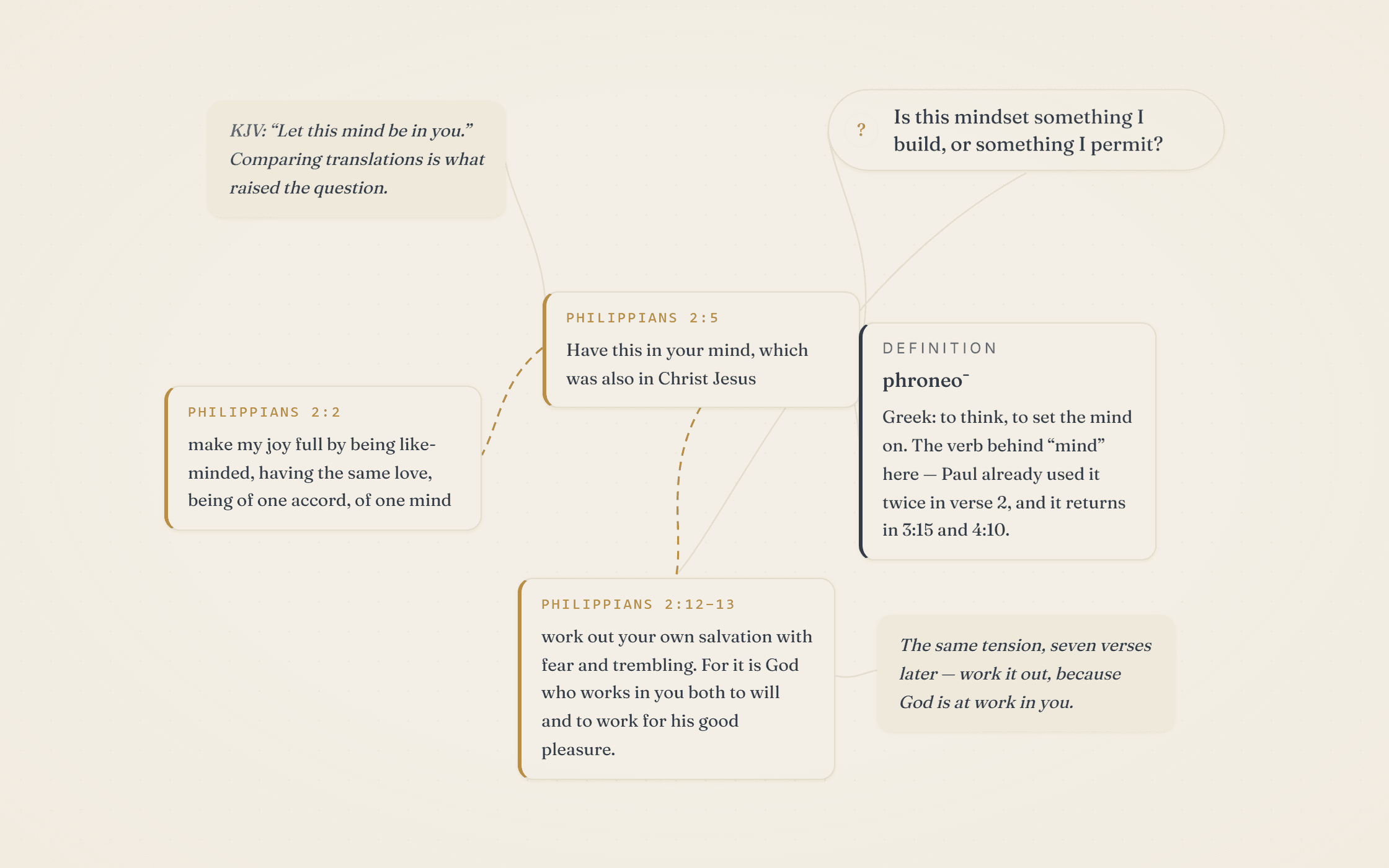
This section's example as a real map — the verse at the center, every branch still connected to the question that raised it.
Start your own in Hodos
4. Cross-reference study: letting Scripture comment on itself
A cross-reference study follows the echoes. Scripture quotes, alludes to, and answers itself constantly; those chains are a commentary older than any study Bible. Start with the small letters in a reference Bible's margin, or any free online reference tool, and follow one echo at a time, always reading the far end in its own context.
When to use it: when a phrase sounds like it came from somewhere else. It usually did.
Following the echo in Philippians 2:10–11
Paul writes that "at the name of Jesus every knee should bow" and "every tongue should confess that Jesus Christ is Lord." The margin sends you centuries back, to Isaiah 45:23: "to me every knee shall bow, every tongue shall take an oath." Read Isaiah 45 whole and the weight lands. In that chapter God insists, again and again, that there is no one beside him — and that is the verse Paul reaches for to describe Jesus. One cross-reference, and a hymn's closing flourish becomes a claim about who Jesus is. Paul cites the same verse in Romans 14:11.
5. Topical study: tracing a theme across Scripture
A topical study starts with a question instead of a passage — anxiety, money, forgiveness, humility — and gathers what Scripture says across many books. Use a concordance or search tool to collect passages, read each one in its own context (this is the step that separates study from proof-texting), then write a synthesis in your own words.
When to use it: when a question will not leave you alone, or you are preparing to lead and teach on a theme.
Tracing humility from Philippians 2:3
Let Philippians 2:3 set the trail, then follow "humility" outward. James 4:6, "God resists the proud, but gives grace to the humble," turns out to be a quotation of Proverbs 3:34, and 1 Peter 5:5 reaches for the same proverb. When two New Testament writers independently quote one proverb, mark it. Add Luke 14:7–11, where Jesus watches dinner guests grab the good seats, and John 13:3–5, where he washes feet knowing all things had been given into his hands. Then synthesize: in Scripture, humility is never self-contempt. It is the posture grace flows toward, practiced most freely by the One who had the least reason to stoop.
6. Book study: reading a letter the way it was written
A book study takes one biblical book over several weeks. Read it in a single sitting, repeatedly; Philippians takes about fifteen minutes aloud. Then outline its argument chapter by chapter, trace its themes, and write one sentence on why it was written. Letters were meant to be heard whole, and this is the only method that hears them that way.
When to use it: when you are ready for cumulative depth and willing to live in one book for a month.
Reading Philippians whole
Read the letter end to end once a week for four weeks. Joy keeps breaking in, from a man writing under Roman guard (Philippians 1:13), and the "mind" language you mapped in chapter 2 returns in chapters 3 and 4. Then the discovery: the hymn of 2:6–11 is not an island. It anchors a sustained appeal to a divided church, sharpened by two real names, Euodia and Syntyche, the quarreling co-workers of 4:2. The passage you studied five ways above was aimed at a specific, painfully ordinary church conflict. Context is not background; it is the point.
Studying by connection: keep a map of your questions
Look back at what these six methods have in common. SOAP trained you to notice. Inductive study traced repetition. Verse mapping branched one verse into a constellation. Cross-referencing followed an echo across the centuries, topical study gathered scattered texts into one picture, and book study held a whole letter in view. Beneath the acronyms, Bible study is one craft: seeing connections, and keeping them.
Keeping them is where notebooks quietly fail. The observation you wrote in March is forty pages back by June. The question Philippians 2:5 raised gets its answer in Romans eight months later, and the two pages never meet.
So here is a seventh practice to lay alongside the six: keep a running map. Give every question its own card. Connect each passage to the question it raised or answered. When a cross-reference lands, draw the line. Over months the map becomes what a journal cannot: a picture of how your understanding actually grew, where every old question stays within reach.
Index cards and a wall will do. We are building Hodos because we wanted the wall to be infinite — a zoomable canvas where you can capture a question mid-study, link verses to it, and zoom out to see years of study as one connected map. It is in open beta — free to try, or join the waitlist to follow along first.
Frequently asked questions
What is the best Bible study method for a beginner?
Start with SOAP. It takes fifteen minutes, builds a daily habit, and trains the read-notice-respond reflex every deeper method depends on. After thirty days, add inductive study for the passages that raise harder questions.
Where should a beginner start reading the Bible?
Begin with a Gospel — Mark is the shortest, John the most reflective — then a brief letter such as Philippians. Starting at Genesis and pushing straight through is how most first attempts stall.
What is the difference between reading the Bible and studying it?
Pace and posture. Reading carries you through the text for the sweep of the story; study stops, asks questions, and stays until some of them are answered. You need both: reading supplies the map, study digs the wells.
How long should Bible study take each day?
As long as you will actually repeat tomorrow. Fifteen focused minutes every day will form more insight, and more of you, than a two-hour session once a month.
Do I need special tools to study the Bible?
A translation you can read comfortably and somewhere to keep what you notice, on paper or digital. A reference Bible or a free online concordance helps with cross-references and topical work. Everything else is optional.